
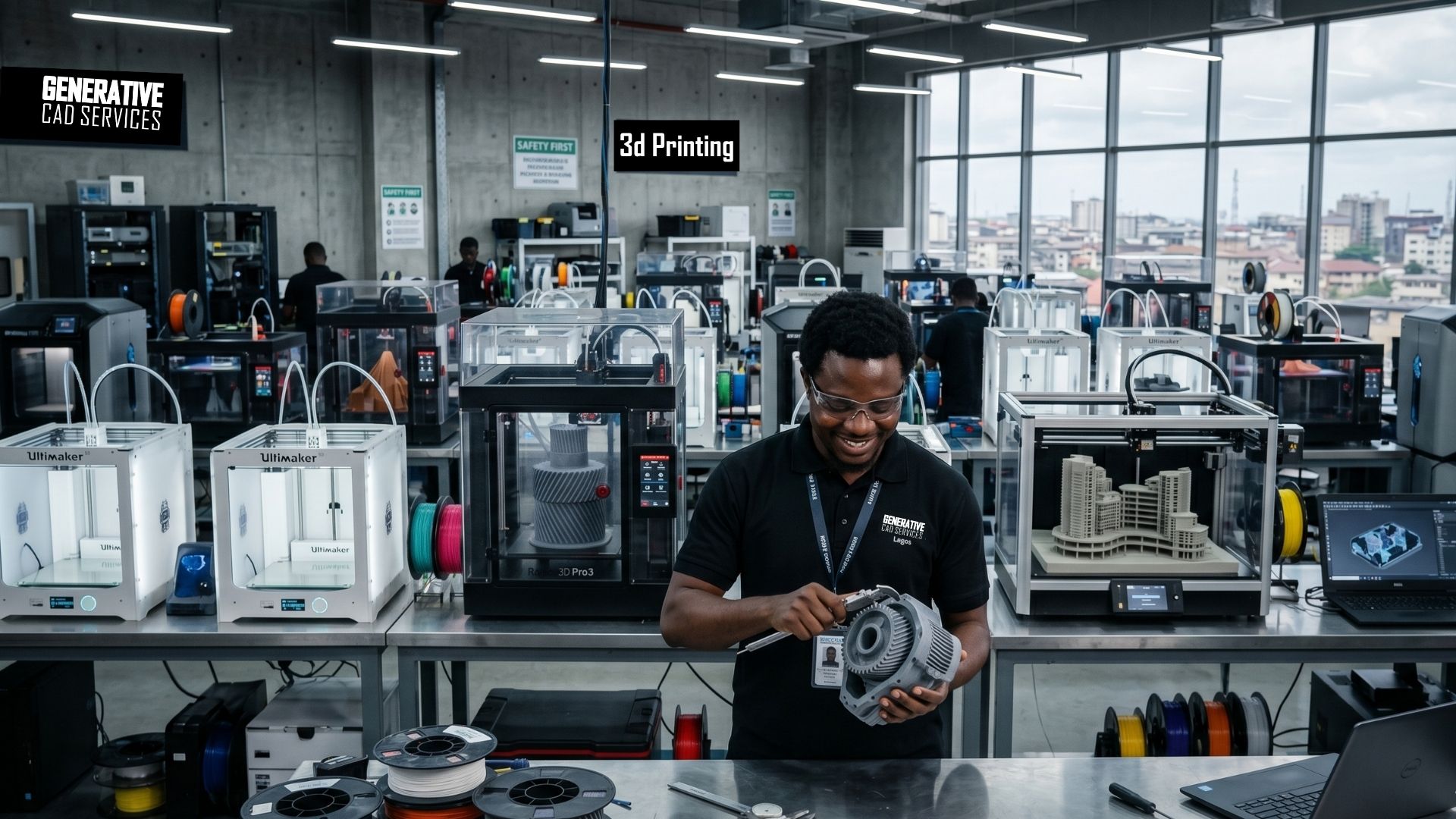
However, before your company sends an RFQ (Request for Quotation) to a local 3D printing hub in Lagos, Abuja or any printing hub in Nigeria, there are several critical factors you need to understand to ensure you get a high-quality, functional part that meets your exact specifications.
Here is what every company needs to know before ordering 3D printed parts.
1. You Need a Print-Ready 3D CAD Model
A common misconception among businesses is that they can send a 2D sketch, a PDF blueprint, or even a photograph to a 3D printing service and have it printed directly.3D printers cannot read 2D drawings; they require a three-dimensional digital model, typically exported as an .STL, .OBJ, or .STEP file. If your company only has a concept or a 2D drawing, the service provider will need to reverse-engineer or design the part from scratch using CAD software, which will add to your total cost and lead time.
If your internal engineering team wants to handle this step themselves to protect intellectual property, enrolling them in professional SolidWorks Training Courses at Generative CAD Academy is the best way to ensure they can create robust, print-ready digital models.
2. Material Selection Dictates Performance
Not all plastics are created equal. The material you choose will dictate the strength, heat resistance, and visual finish of your final part. When consulting with a 3D printing service, you should clearly state the end-use of the part.- PLA (Polylactic Acid): Best for visual prototypes, architectural models, and non-functional testing. It is cost-effective but melts under high heat.
- ABS & PETG: Ideal for mechanical parts that need to endure stress, impact, and outdoor environments.
- TPU (Flexible): Perfect for custom gaskets, phone cases, and anything that requires rubber-like elasticity.
If your company eventually decides to bring production in-house, understanding these thermoplastics is vital. You can browse the standard industrial materials used in these processes via our catalog of high-quality 3D printing filaments.
3. Understand Tolerances and Post-Processing
3D printing builds parts layer by layer, meaning the surface will naturally have faint layer lines. If you require a perfectly smooth, injection-molded finish, you will need to request post-processing services like sanding, priming, and painting. Furthermore, while modern 3D printers are incredibly accurate, you must communicate any strict dimensional tolerances required for your mechanical assemblies to ensure the final print fits perfectly.4. Outsourcing vs. Bringing It In-House
For companies that only need a prototype once or twice a year, utilizing a local 3D printing service is highly economical. It saves you the overhead of machine maintenance and operator training.However, if your Research and Development (R&D) department is iterating on designs weekly, it might be time to invest in your own machinery. Modern desktop machines have become incredibly fast and user-friendly. For example, if you read our recent Flashforge Adventurer 5M Review, you will see how today's CoreXY printers can deliver industrial speeds at a fraction of historical costs.
When you are ready to make the transition, Generative CAD is your premier local vendor for professional 3D printers, offering seamless installation and technical support tailored for Nigerian businesses.
Conclusion
Outsourcing your prototyping to a 3D printing service in Nigeria is a brilliant way to innovate rapidly without heavy upfront capital. By understanding your CAD requirements, selecting the right materials, and knowing when to eventually bring the technology in-house, your business can maximize the incredible benefits of additive manufacturing.Visit us today at: 26, Akinwale Street, Off Yaya Abatan Road, Ogba, 100218, Lagos, Nigeria
Send us an Email at: info@generativecad.com | Call/WhatsApp: +234 703 324 8607

 Search