
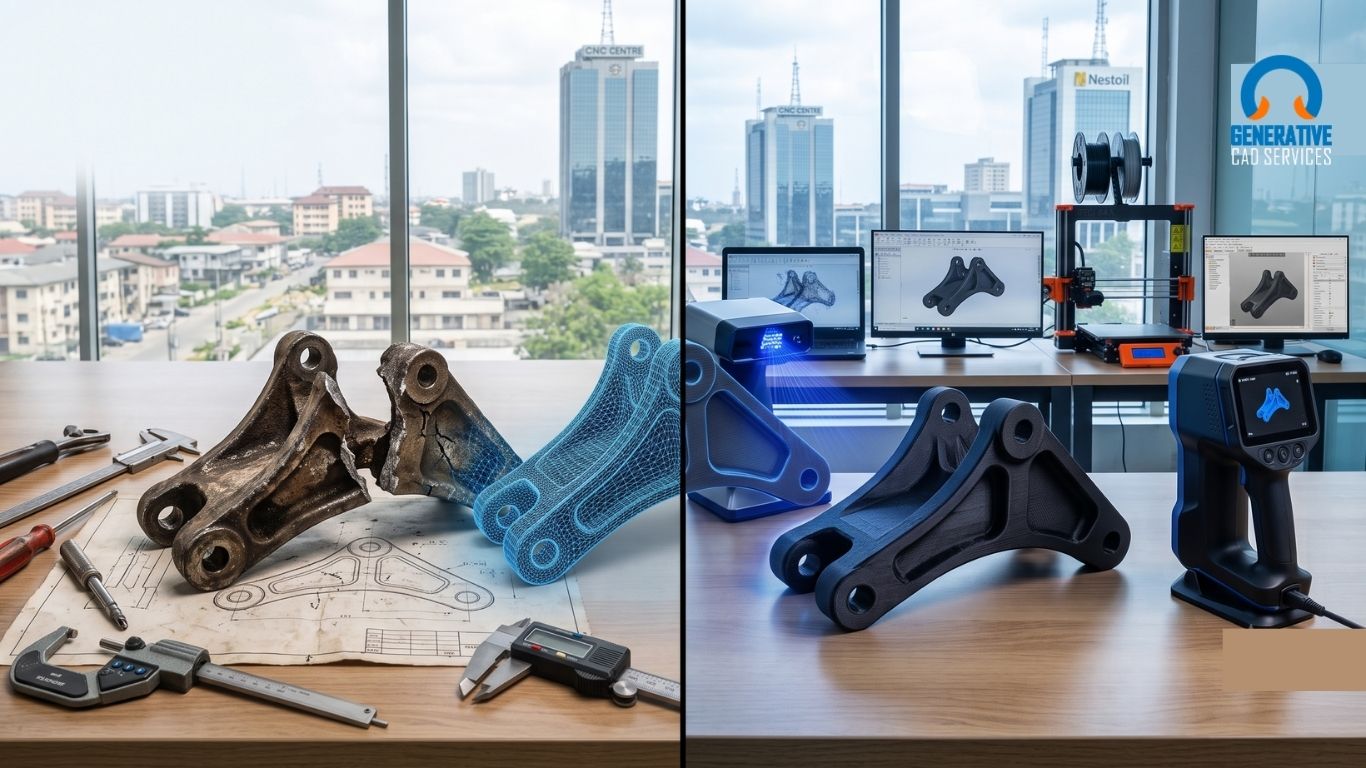
What is it?
It is a reverse engineering process that digitizes physical fragments to build a functional digital twin.
Who is it for?
Manufacturers, engineers, and everyday consumers needing to replace obsolete, custom, or expensive broken parts.
How does it work?
High-precision light or lasers capture the broken geometry; software repairs the missing gaps; and a 3D printer creates the physical replacement.
When should you use it?
When original equipment manufacturer (OEM) parts are unavailable, too costly, or prone to repeated failure.
How can Generative CAD help?
We offer end-to-end 3D scanning and 3D printing services Nigeria to restore your critical assets quickly.
Can Broken Parts Be Recreated? The Four-Step Restoration
When a critical component breaks, it no longer means the end of a machine's lifespan. Utilizing a professional physical object to CAD service Nigeria, the restoration process is highly strategic:
Manufacturers, engineers, and everyday consumers needing to replace obsolete, custom, or expensive broken parts.
When original equipment manufacturer (OEM) parts are unavailable, too costly, or prone to repeated failure.
We offer end-to-end 3D scanning and 3D printing services Nigeria to restore your critical assets quickly.
- Scanned: We piece the broken fragments together as closely as possible and capture them using the best 3D scanner for reverse engineering.
- Remodeled: The raw scan data is imported into CAD software where the "break" is digitally healed and smoothed out.
- Improved: If the part broke because of a design flaw, our reverse engineering services Lagos allow us to thicken walls, add structural ribs, and optimize the geometry to ensure the new part is stronger than the original.
- Printed: We then scan and 3D print a part in Lagos, delivering either rapid prototypes for fit-testing or durable final replacements.
What is 3D Scanning?
3D scanning is a non-destructive technology that analyzes a physical object and collects data on its shape and appearance. It projects light onto the object to create a digital "point cloud" that perfectly maps its contours. Leveraging the best 3D scanner for product design, engineers can translate real-world items into highly accurate 3D CAD models, bypassing traditional, error-prone manual measurements.What Kinds of Objects Can Be Scanned?
From micro-gears that fit on your fingertip to massive industrial engine blocks, modern scanners are incredibly versatile. We deploy the best 3D scanner for small objects for intricate items and larger tracking systems for heavy machinery. Whether you need a comprehensive object scanning service Lagos for automotive components or consumer electronics, scale is rarely an issue.How Does Scan-to-Print Work?
The scan-to-print workflow bridges the physical and digital gap. First, the object is prepared and scanned. Second, the resulting mesh data is cleaned up and reverse-engineered into a solid, editable CAD model. Finally, the optimized file is sent to a 3D printer to produce the physical part.For a more detailed, technical walkthrough of this exact workflow, check out our comprehensive guide: How to Turn a Physical Object into a 3D Model Using 3D Scanning.
Industry Use Cases
The ability to recreate and digitize parts is transforming multiple sectors:- Spare Parts: 3D scanning for spare parts Nigeria keeps legacy machinery running when OEMs stop producing replacements.
- Manufacturing: 3D scanning for manufacturing companies in Nigeria ensures rapid tooling and stringent quality control.
- Product Design: Designers use it to iterate on physical mockups and perfect ergonomics.
- Education: Digitizing complex mechanics for virtual classrooms.
- Healthcare Training: Creating custom prosthetics and anatomical models based on actual patient scans.
- Architecture/Models: Scaling down large environmental spaces or heritage sites.
- Creative Industries: Exporting physical props into digital video game environments.

 Search