
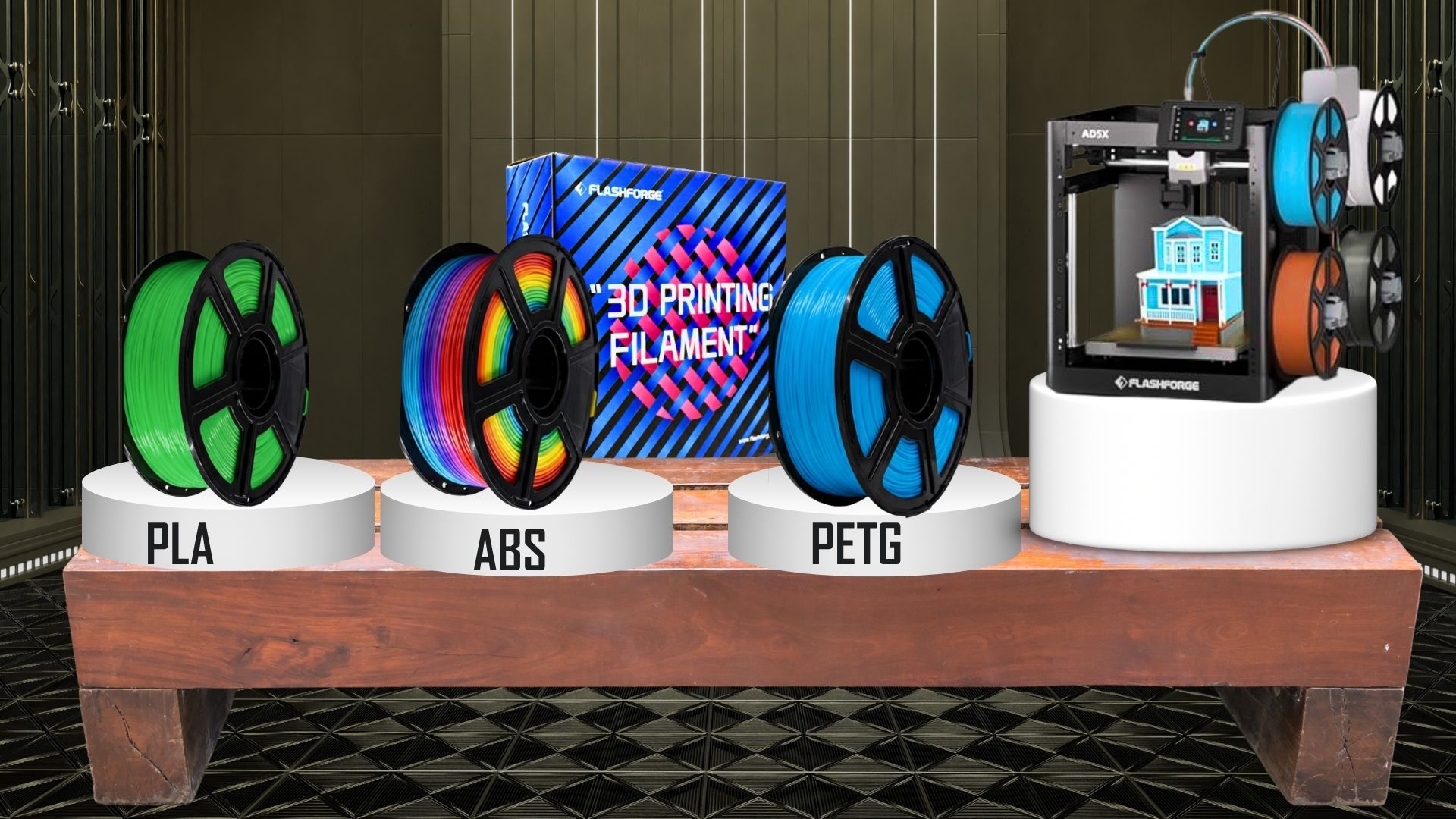
In the realm of FDM (Fused Deposition Modeling) 3D printing, plastic filament is your ink. However, not all plastics are created equal. The material you choose will dictate how easy your part is to print, how strong it will be, and how well it withstands heat and environmental stress.
In this guide, we break down the three most common 3D printing filaments PLA, ABS, and PETG to help you choose the right material for your next project.
1. PLA (Polylactic Acid): The Beginner’s Best Friend
If you are new to 3D printing, PLA is exactly where you should start. Derived from renewable resources like corn starch or sugarcane, PLA is the most popular filament on the market.Why we love it:
- Incredibly Easy to Print: PLA melts at a relatively low temperature (around 190°C - 210°C) and rarely warps, meaning it adheres easily to the print bed without requiring an enclosure.
- Great Visual Finish: It produces sharp, highly detailed models with a glossy surface, making it perfect for architectural models, figurines, and visual prototypes.
The Catch: PLA is quite brittle. It is not suitable for mechanical parts that need to bend or withstand heavy impacts. Furthermore, it has a low glass transition temperature; if you leave a PLA print in a hot car in Lagos, it will warp and deform.
2. ABS (Acrylonitrile Butadiene Styrene): The Industrial Standard
ABS is the exact same tough plastic used to make Lego bricks. If you need a functional, durable part that can take a beating, ABS is a heavy hitter.Why we love it:
- High Durability & Heat Resistance: ABS can withstand high impact and high temperatures without deforming. It is perfect for automotive parts, protective casings, and functional mechanical gears.
- Post-Processing: ABS can be easily sanded, drilled, and even smoothed using acetone vapors for an injection-molded look.
The Catch: ABS is notoriously difficult for beginners to print. It requires a high nozzle temperature (230°C - 250°C) and a heated bed. More importantly, it shrinks as it cools. To print ABS successfully without the model warping or splitting apart, you must use an enclosed 3d printing machine. If you are planning to print with ABS, we highly recommend upgrading to one of our enclosed, professional high-performance 3D printers designed specifically to handle high-temperature materials.
3. PETG (Polyethylene Terephthalate Glycol): The Best of Both Worlds
If PLA is too weak and ABS is too hard to print, PETG is the perfect middle ground. It is an enhanced version of the plastic used to make water bottles.Why we love it:
- Strong and Flexible: PETG is highly impact-resistant and has a slight flexibility that prevents it from snapping under pressure.
- Chemical and Water Resistant: It holds up beautifully outdoors, making it ideal for mechanical parts exposed to the elements or moisture.
- Easier than ABS: While it requires higher temperatures than PLA, PETG does not require a fully enclosed printer, making it much more accessible for desktop users.
The Catch: PETG is prone to "stringing" (leaving thin, spider-web-like hairs between printed parts) and requires careful tuning of your printer’s retraction settings to get a perfectly clean print.
Sourcing Your Materials and Services
Choosing the right filament is critical, but the quality of the spool matters just as much. Cheap, low-quality filament can suffer from moisture absorption and inconsistent diameters, leading to clogged nozzles and failed prints. To guarantee a smooth printing experience, always source your materials from trusted vendors. Browse our comprehensive selection of high-quality 3D printer filaments tailored for professional results.Alternatively, if your company needs high-strength ABS or PETG parts but you don't have the time or hardware to print them in-house, you don't have to miss out on the benefits of additive manufacturing. Read our recent guide on 3D Printing Services in Nigeria: What Companies Should Know Before Ordering to learn how you can outsource your advanced prototyping seamlessly.
Conclusion
In summary, use PLA for easy, highly detailed visual models; use ABS when you need high heat resistance and industrial strength (provided you have the right printer); and use PETG as your go-to material for durable, functional parts that are easy to print.
Visit us today at: 26, Akinwale Street, Off Yaya Abatan Road, Ogba, 100218, Lagos, Nigeria
Email: info@generativecad.com | Call/WhatsApp: +234 703 324 8607

 Search