
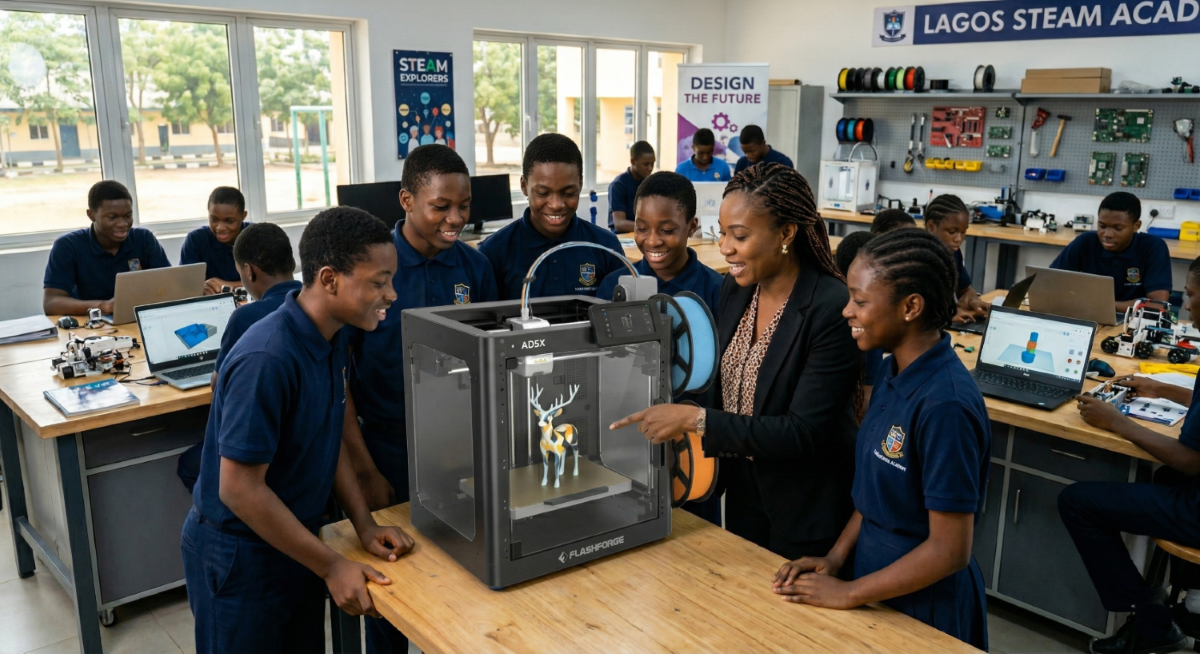
The traditional African classroom is undergoing a profound transformation. Across Nigeria, rote memorisation and purely theoretical instruction are making way for active, experiential learning. School administrators, curriculum directors, and educational policymakers are realising that to prepare students for the global digital economy, we must move them from mere consumption to production.
However, transitioning from traditional teaching to a modern, innovation-driven curriculum requires more than just goodwill; it requires the right localised educational infrastructure.
If you are tasked with upgrading your institution's practical learning facilities, this guide will walk you through exactly how to equip a future-ready STEAM (Science, Technology, Engineering, Arts, and Mathematics) lab that bridges critical skills gaps and turns students' ideas into real-world impact.
The Evolution of STEAM Education in West Africa
For decades, the missing link in Nigerian secondary and tertiary education has been hands-on practical application. Students could explain complex physics theories but lacked the tools to prototype functional solutions.
Today, that narrative is changing. We are witnessing a decisive shift toward problem-solving curricula, championed by both private institutions and public-private educational partnerships. Technologies like 3D printing are no longer viewed as futuristic luxuries; they are foundational tools that democratise access to engineering and design. Localised infrastructure is now a necessity to ensure that African students do not just participate in the modern workforce, but actively lead it.
Core Pillars of a Modern Digital Manufacturing Lab
Building an effective STEAM lab goes far beyond buying a piece of hardware. It requires a carefully configured ecosystem of reliable machines, professional software, safe and high-quality consumables. Here are the essential components needed to take your students from idea to impact.
1. Reliable Additive Manufacturing Hardware (3D Printers)
The cornerstone of any modern makerspace is the 3D printer. However, consumer-grade printers are often ill-suited for the rigours of a bustling classroom. Educational hardware must meet strict criteria: it must be exceptionally safe, highly reliable, and easy for both educators and students to operate.
For Nigerian classrooms, fully enclosed chambers are non-negotiable to protect students from moving parts and heated elements. This is why we strongly recommend the Flashforge Adventurer 5X, Flashforge Adventurer 5M Pro and the Flashforge Adventurer 5M as the ideal desktop solutions. Designed specifically with educational environments in mind, they offer seamless integration, rapid print speeds, and the robust durability required to withstand daily student use.
2. Industry-Standard 3D Design Software
A 3D printer is only as powerful as the digital design that feeds it. A common pitfall in educational procurement is investing in hardware while ignoring software, or worse, training students on rudimentary tools that have no real-world application.
To truly bridge the engineering skills gap, schools must teach the software that top global enterprises actually use. Equipping your lab with professional CAD (Computer-Aided Design) tools ensures students graduate with highly employable skills. Through Autodesk Learning Partner solutions and SolidWorks educational licenses, institutions can provide students with the exact digital canvases used by the world's leading engineers and architects.
3. Safe, High-Yield Consumables
In an enclosed classroom environment, the safety and quality of your printing materials are paramount. Schools must prioritise non-toxic, reliable, and environmentally friendly filaments that do not emit harmful fumes during the melting process.
Flashforge PLA Pro Filament is the gold standard for STEAM labs. Derived from renewable resources like corn starch, it is completely safe for indoor classroom use, incredibly easy to print with, and yields high-quality, durable prototypes for student projects.
Bridging the Skills Gap: Curriculum Integration
Procuring the equipment is only step one; the true value of a STEAM lab is unlocked through curriculum integration. Hardware is ultimately useless without a framework that connects it to everyday learning.
We have seen remarkable results when teachers cross-pollinate 3D printing across subjects. Biology teachers are printing anatomically accurate human hearts to explain cardiovascular systems; geography teachers are printing topographical maps; and mathematics teachers are utilising geometric shapes to bring abstract calculus to life. By integrating digital manufacturing into daily lesson plans, schools foster genuine, multidisciplinary innovation.
Why Localised Support and Authorised Warranties Matter
Historically, the biggest pain point for African educational institutions has been the procurement of imported hardware with zero local support. A printer goes down, a part breaks, and the entire lab stalls for months waiting for overseas assistance.
To ensure operational continuity, it is critical to partner with an authorised regional distributor. Generative CAD is the official distributor for Flashforge in West Africa. We do not just supply hardware; we provide the localised support, comprehensive warranties, and hands-on teacher training necessary to ensure your lab remains a functional, thriving hub of innovation year-round.
Funding and Public-Private Partnerships
Equipping a state-of-the-art STEAM lab is a significant investment, but schools do not have to shoulder the burden alone. There is a growing ecosystem of public-private partnerships, educational grants, and corporate social responsibility (CSR) initiatives focused on democratising technology in Africa. By aligning your procurement strategy with national goals for workforce development and technological advancement, your institution can attract funding and ecosystem networks eager to sponsor the next generation of African makers.
Take the Next Step in Educational Innovation
The fastest path from an idea to tangible impact is firsthand, hands-on learning. If your institution is ready to move beyond traditional boundaries and equip a lab that will define the future of your students, we are here to help.
We invite school administrators and curriculum directors to consult with us directly for a customised, scalable educational solution. Explore our Configurable Solutions to find the perfect fit for your institution's unique needs and budget.
📍 Visit us at: 26, Akinwale Street, Off Yaya Abatan Road, Ogba, 100218, Lagos, Nigeria
📧 Email: info@generativecad.com
📞 Call/WhatsApp: +234 703 324 8607
Empowering Africa’s innovators, educators, and builders to create a better tomorrow.

 Search