
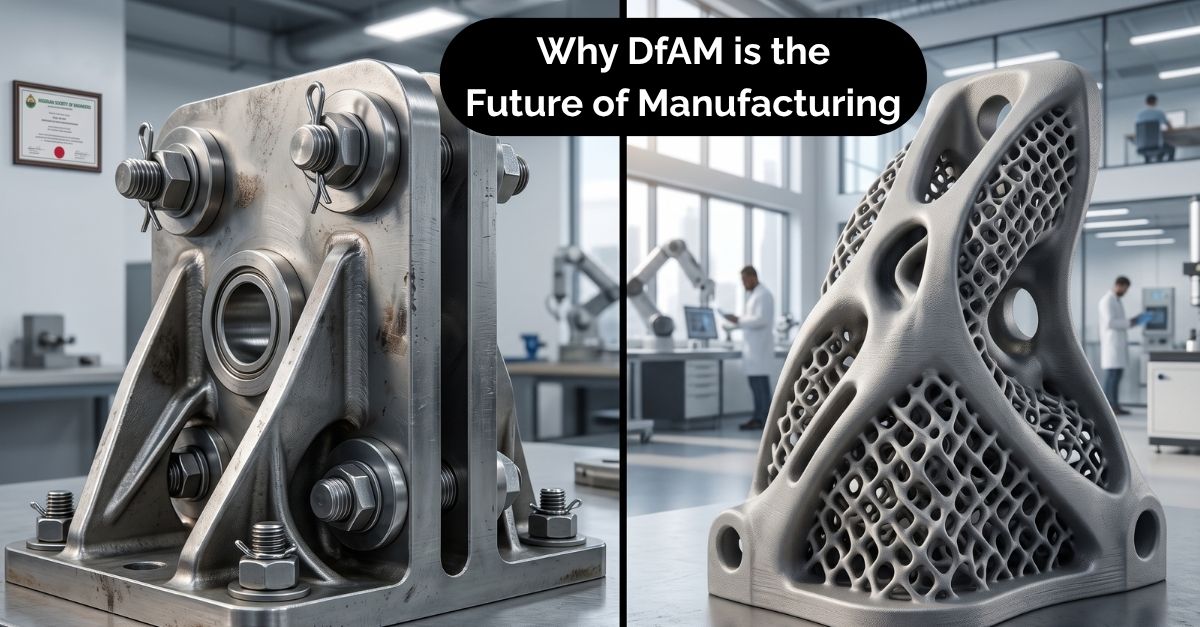
Today, that paradigm has flipped. With the maturity of industrial 3D printing, the design now dictates the tools. To truly harness this power, businesses must embrace Design for Additive Manufacturing (DfAM).
But why exactly is DfAM no longer just a buzzword, but an absolute necessity for the future of manufacturing?
Breaking Free from Traditional Constraints
If you read our foundational guide, What is Design for Additive Manufacturing (DfAM)?, you understand that DfAM requires a total rewiring of the engineer's mindset. When you are no longer constrained by the physical limitations of a drill bit or a milling cutter, the possibilities expand exponentially.DfAM is the future because it allows engineers to prioritize function over manufacturability. You don't have to compromise a part's performance simply because it's too difficult to machine. If a complex, organic shape performs better, a 3D printer can build it layer by layer just as easily as a simple cube.
1. Unprecedented Lightweighting
One of the primary drivers making DfAM the future of manufacturing is lightweighting. In industries like aerospace, automotive, and logistics, every single gram of weight saved translates directly into lower fuel consumption and increased efficiency over the lifespan of a vehicle.Through DfAM techniques like topology optimization (often utilizing generative design software), engineers can input the exact stress loads a part will face. The software mathematically calculates the optimal shape, removing material where it isn't needed and reinforcing areas of high stress. The result is often a bizarre, organic-looking structure that resembles bone or coral.
These lattice structures maintain the exact same structural integrity as a solid block of metal but can weigh 40% to 60% less. Traditional CNC machines simply cannot manufacture these internal lattices; only additive manufacturing can.
2. Revolutionary Part Consolidation
Look at any traditional machine an engine, a pump, or even a simple consumer appliance. It is likely composed of dozens, if not hundreds, of individual parts fastened together with screws, bolts, and welds.DfAM introduces the concept of part consolidation. Engineers can redesign an entire assembly containing 20 different components into a single, highly complex 3D-printed part.
The cascading benefits for a manufacturing business are immense:
- Zero Assembly Time: You eliminate the labor costs and time required to put the pieces together.
- Fewer Points of Failure: Every weld or screw is a potential weak point. A single, unified part is inherently stronger and more reliable.
- Simplified Supply Chains: Instead of sourcing, shipping, and warehousing 20 different parts from 5 different suppliers, you print one part locally.
Elevate Your Engineering Capabilities
The transition from subtractive to additive design is not intuitive; it requires dedicated education and practical application. If your company relies on engineering talent, upskilling your workforce in DfAM principles is a critical investment for future competitiveness.We provide comprehensive, structured education to help engineers make this leap. Enroll your team in our specialized Professional 3D CAD and DfAM Training at Generative CAD Academy to master topology optimization, lattice structures, and part consolidation.
Join an exclusive routine Webinars designed for aspiring engineers, product designers, innovators, and technology enthusiasts looking to build industry-relevant skills in Product Design, Development, CAD workflows, and Design for Additive Manufacturing (DfAM).
Learn how modern engineering teams use digital product development and additive manufacturing to create innovative products for the future.
This free webinar session will also provide insights into the upcoming Cohort 2 training program by GCAD Academy, sign up here.
Note, DfAM is not just about making things differently; it is about making things better. By enabling extreme lightweighting, massive part consolidation, and unrestricted geometric freedom, DfAM represents the next industrial revolution. Companies that adopt these methodologies today will design the superior, hyper-efficient products of tomorrow.
Visit us at: 26, Akinwale Street, Off Yaya Abatan Road, Ogba, 100218, Lagos, Nigeria
Email: info@generativecad.com | Call/WhatsApp: +234 703 324 8607

 Search